Safety
MOA and TFR Alerts on Your iPad: The Rules and How Alerts Work
November 15, 2026 · 10 min read · by Vincent Wu, Founder, Ascent EFB
Covers features in Ascent 1.9.9 and later.
Try Ascent EFB
Free for 30 days, then $59.99 your first year
One plan with everything in it: 3D terrain, geo-referenced FAA charts, the full weather stack and live traffic, all cached offline. $89.99 a year after the first. One trial per account, no card needed to look around.
Start a 30-day trialBy Vincent Wu, founder of Ascent EFB. Last updated November 15, 2026.
TL;DR: Not all special use airspace is off limits. VFR through an active MOA is legal, though the AIM says to exercise extreme caution and to contact the controlling agency first. Restricted and prohibited areas need permission. TFRs, issued by NOTAM under 14 CFR 91.137 through 91.145, are where pilots get intercepted and lose certificates, and the DC SFRA and FRZ have their own rules in 14 CFR Part 93. A good airspace alert on an EFB projects your track forward and warns you minutes before the boundary, and with a flight plan it looks further down the route. It only knows about the TFRs in its last download, so refresh before you fly. Ascent 1.9.9 does this on the device with a 5 minute heads-up and a 2 minute warning.
Can you fly VFR through an active MOA, and what does an EFB airspace alert actually do?
Yes, VFR flight through an active MOA is legal. MOAs exist to separate military training from IFR traffic, and the AIM tells VFR pilots to exercise extreme caution and contact the controlling agency for traffic advisories before entering. Restricted and prohibited areas, TFRs and the DC FRZ are different: entering without authorization is a violation. A predictive EFB alert projects your track ahead and warns you a few minutes before you would cross a boundary, using the airspace data you last downloaded.
The airspace that bites, and the actual rule for each
The AIM covers special use airspace in chapter 3, section 4. The regulations behind it are mostly in 14 CFR Part 91. Here is the short version.
| Airspace | Can a VFR pilot enter? | Source |
|---|---|---|
| Prohibited area | No, except with permission of the using or controlling agency | 14 CFR 91.133, AIM 3-4-2 |
| Restricted area | Not contrary to its restrictions; entry without authorization "may be extremely hazardous" | AIM 3-4-3, 14 CFR 91.133 |
| Warning area | Yes, but it contains activity that may be hazardous to nonparticipating aircraft | AIM 3-4-4 |
| MOA | Yes. Extreme caution when active; contact the controlling agency first | AIM 3-4-5 |
| Alert area | Yes. Participants and transiting pilots are equally responsible for collision avoidance | AIM 3-4-6 |
| TFR | Only if you fit an exception in the specific NOTAM | 14 CFR 91.137 to 91.145 |
| DC SFRA | Yes, with two-way radio contact with ATC, an altitude-reporting transponder on an ATC-assigned discrete code, and for VFR an activated SFRA flight plan unless exempt | 14 CFR 93.339 |
| DC FRZ | Only with authorization, apart from the procedures for the three Maryland airports | 14 CFR 93.341, 93.343 |
MOAs
AIM 3-4-5 says MOAs are established "for the purpose of separating certain military training activities from IFR traffic." They do not prohibit VFR traffic. What the AIM does say is that "Pilots operating under VFR should exercise extreme caution while flying within a MOA" when military activity is being conducted, and that "Prior to entering an active MOA, pilots should contact the controlling agency for traffic advisories." A call to the controlling agency tells you whether the MOA is actually active right now.
Practical upshot: an MOA alert is not a stop sign. It is a prompt to call, ask whether it is hot, and decide whether to go through, over or around.
Restricted and prohibited areas
14 CFR 91.133 says no one may operate in a prohibited area without permission of the using or controlling agency, or in a restricted area contrary to the restrictions imposed. AIM 3-4-3 is blunter about the reason: penetration of restricted areas without authorization "may be extremely hazardous."
Warning and alert areas
AIM 3-4-4 says a warning area contains activity that may be hazardous to nonparticipating aircraft. For alert areas, AIM 3-4-6 says pilots of participating aircraft and pilots transiting the area "must be equally responsible for collision avoidance." Neither needs permission.
TFRs
Temporary flight restrictions are issued by NOTAM under several sections of Part 91. Among them: 91.137 covers hazards and disaster relief, 91.141 covers flight near the President, Vice President and other public figures, and 91.145 covers aerial demonstrations and major sporting events, usually published by NOTAM at least 30 days in advance. Part 99 adds special security instructions in defense airspace, and the everyday stadium TFRs come from those special security instructions under 14 CFR 99.7, not from 91.145. Each TFR has its own exceptions, so the NOTAM text is the rule, not the circle on the map.
TFRs are where the consequences are real. In March 2025, AOPA reported that NORAD had written to general aviation pilots after a noticeable uptick in TFR violations, and noted media reports that fighters had intercepted several GA aircraft violating TFRs around Palm Beach, Florida. NORAD listed possible outcomes including a visit from law enforcement, a Brasher notification, significant fines, and suspension or loss of a certificate. If you are intercepted, the same piece says to contact 121.5 or 243.0 MHz and reverse course until given instructions. NORAD's point was simple: checking NOTAMs is an FAA requirement, not an option, and many TFRs appear at short notice.
The DC SFRA and FRZ
The Washington DC Special Flight Rules Area covers the airspace within 30 miles of the DCA VOR/DME, and it contains the Flight Restricted Zone, an irregular area roughly 13 to 15 nautical miles around the DCA VOR/DME (14 CFR 93.335). Inside the SFRA you need an operable two-way radio and contact with ATC, an altitude reporting transponder squawking an ATC-assigned discrete code, and, for VFR, a filed and activated SFRA or FRZ flight plan. Code 1200 may not be used (93.339). The FRZ is closed to most Part 91 flights without an FAA and TSA authorization (93.341). And separately, 14 CFR 91.161 requires any pilot flying VFR within 60 nautical miles of the DCA VOR/DME to have completed the FAA's Special Awareness Training.
How a predictive airspace alert works
An alert that fires when you are already inside a TFR is a confession, not a warning. A useful alert looks ahead.
The method is geometry. Take your current position, ground track, groundspeed and altitude. Project a short line forward along the track for a few minutes. Test that line against every airspace volume nearby: its lateral boundary, its floor and ceiling, and whether it is active at the time you would arrive. If the projected line enters a volume, raise an alert with the time to entry.
A few design choices decide whether this helps or nags.
Lead time. A heads-up several minutes out gives you time to call the controlling agency or turn. A second, closer warning says the turn needs to happen now.
Unknowns. Airspace data is messy. A NOTAM may not parse into clean times, or an area may lack an altitude. A cautious system treats an unknown time as active and an unknown altitude as in range, accepting some false alarms instead of missing the real one.
Altitude. A Class B shelf you are under is not a threat. An alert that ignores altitude will cry wolf until you turn it off, which is worse than no alert.
The flight plan. A straight-line projection only sees what is ahead of the nose. If your route turns in 20 miles toward a TFR, a projection along the current track will not see it until after the turn. Running the same test down the rest of the planned route at your groundspeed catches it earlier, while you can still amend the route instead of dodging.
Planning time. The cheapest airspace alert is the one you get before engine start. If the route crosses a TFR, restricted area or the SFRA, the planning screen should say so.
Why snapshots must be refreshed before every flight
Every EFB alert is only as good as the airspace data it holds. TFRs and NOTAM areas come and go, and as NORAD noted, some appear at the last minute.
If the device has no connection in flight, which is normal for a cellular-free iPad at altitude, its TFR knowledge is frozen at the last download. That is true of every app. ForeFlight's own TFR alert video, for example, says the app can only warn about TFRs it knows about and tells pilots to update TFR data before every flight.
So the preflight habit is: download the latest data, check the NOTAMs for your route as part of your briefing, then fly with alerts as a backstop, not as the briefing.
What ForeFlight publishes about its alerts
This section is context for pilots comparing apps. As read on foreflight.com on November 15, 2026, ForeFlight publishes TFR alerts that warn when it detects you will enter or pass near a TFR within the next five minutes, working whether or not the TFR layer is shown, and controlled airspace alerts that by default trigger three minutes out and within 500 feet of the airspace altitude. Check their current documentation for details and plan requirements.
How Ascent's airspace alerts work
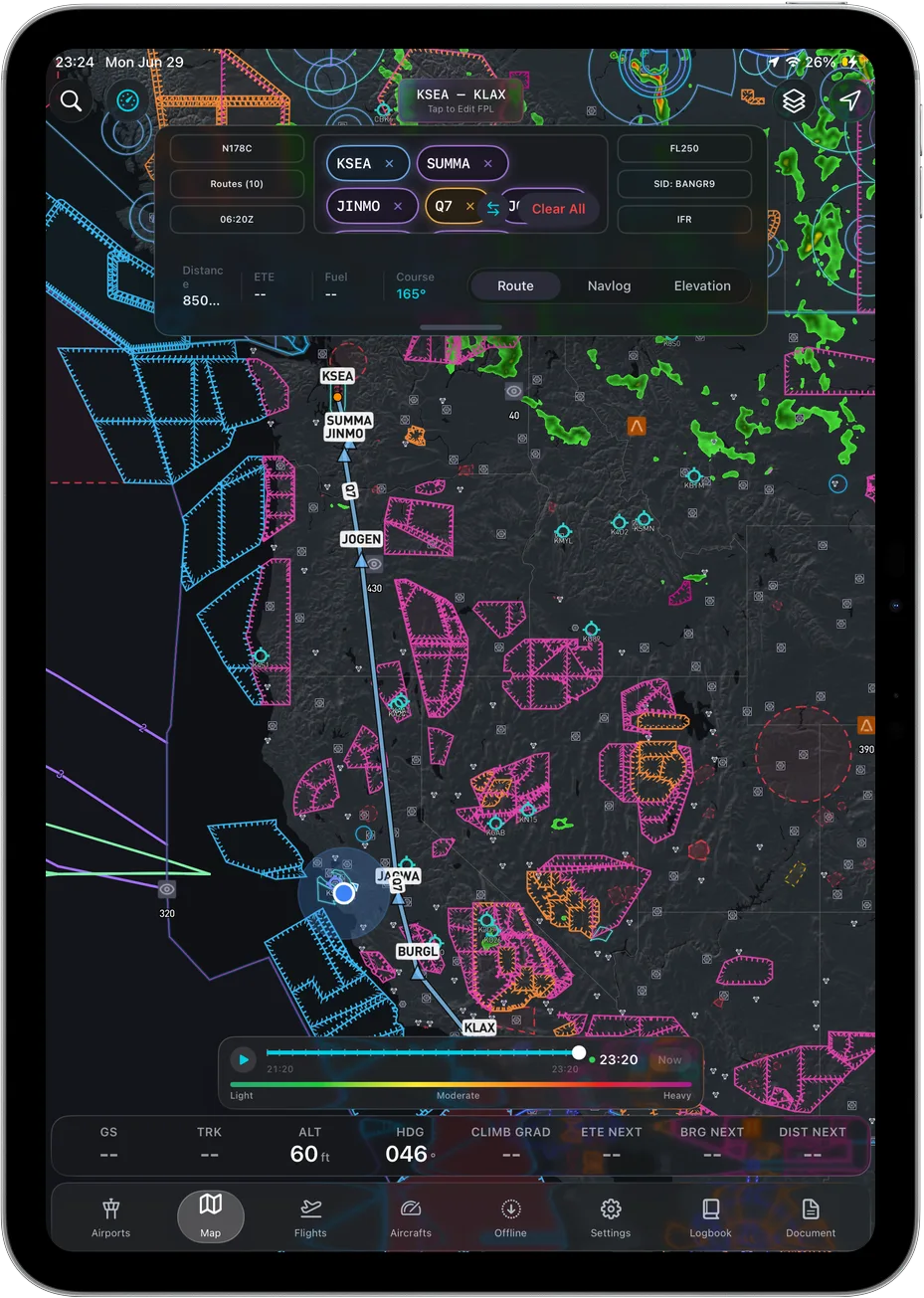
Ascent's airspace alerts are on by default. They project your track forward and give a heads-up 5 minutes and a warning 2 minutes before you would enter an active TFR, the DC SFRA or FRZ, prohibited or restricted airspace, Class B, C or D, a MOA, a warning or alert area, or an area defined by a NOTAM. For a MOA, the alert tells you to check activity with ATC rather than treating it as off limits. Unknown times count as active and unknown altitudes as in range.
With a flight plan active, Ascent 1.9.9 also checks down the rest of the route at your groundspeed and says to amend the route. While you plan, the route tab flags a route that crosses a TFR, the SFRA or FRZ, or restricted or prohibited airspace. Voice callouts are optional. Alerts stay off for simulator sessions unless you opt in.
It is deterministic geometry computed on the iPad or iPhone, not AI, and it runs against your installed offline packs, so it works with no signal.
The limits, plainly. TFRs and NOTAM areas are as of your last download, so refresh before you fly. It needs current offline packs for the area you fly; if a pack is missing, Settings says which airspace is not being watched. It does not alert for terrain or fuel. It is a supplemental aid, and clearances, NOTAMs and the chart remain your responsibility. Details on the airspace alerts feature page.
Ascent is $59.99 the first year, then $89.99 a year, after a one-time 30-day Pro trial, on iPhone and iPad with iOS 18.0 or later.
Frequently asked questions
Is it legal to fly VFR through an active MOA?
Yes. MOAs separate military training from IFR traffic. AIM 3-4-5 says VFR pilots should exercise extreme caution in an active MOA and contact the controlling agency for traffic advisories before entering.
What happens if I fly into a TFR?
You may be intercepted. AOPA's March 2025 report on NORAD's letter lists possible outcomes including a visit from law enforcement, a Brasher notification, significant fines, and suspension or loss of your certificate.
Do EFB airspace alerts work without internet?
Some do. Ascent's run on the device against your installed offline packs. Without a connection, TFRs and NOTAM areas are as of the last download, so refresh before departure.
Related reading: backup EFB setup on a second iPad, whether a Wi-Fi iPad has GPS, and how Ascent and ForeFlight compare on price.
Sources
- FAA, Aeronautical Information Manual chapter 3, section 4, Special Use Airspace (paragraphs 3-4-2 to 3-4-6), as reproduced by Gleim FAR/AIM, read November 15, 2026
- 14 CFR 91.133, Restricted and prohibited areas, read November 15, 2026
- 14 CFR 91.137, Temporary flight restrictions in the vicinity of disaster/hazard areas, read November 15, 2026
- 14 CFR 91.141, Flight restrictions in the proximity of the Presidential and other parties, read November 15, 2026
- 14 CFR 91.145, Management of aircraft operations in the vicinity of aerial demonstrations and major sporting events, read November 15, 2026
- 14 CFR 99.7, Special security instructions, read November 15, 2026
- 14 CFR 91.161, Special awareness training required for pilots flying under VFR within a 60-nautical mile radius of the Washington, DC VOR/DME, read November 15, 2026
- 14 CFR 93.335, Definitions (DC SFRA and FRZ), read November 15, 2026
- 14 CFR 93.339, Requirements for operating in the DC SFRA, read November 15, 2026
- 14 CFR 93.341, Aircraft operations in the DC FRZ, read November 15, 2026
- AOPA, NORAD reminds GA pilots to check notams, Jay Wiles, March 13, 2025
- ForeFlight, TFR Alerts quick tips and Controlled Airspace Alerts, read November 15, 2026
Written by Vincent Wu, founder of Ascent EFB at Geospatios. Airspace alerts are in Ascent 1.9.6 and later, with MOAs, warning and alert areas, NOTAM areas and flight plan look-ahead added in the releases since. Any EFB is a supplemental aid. Final authority rests with the pilot in command.
Try Ascent EFB
Free for 30 days, then $59.99 your first year
One plan with everything in it: 3D terrain, geo-referenced FAA charts, the full weather stack and live traffic, all cached offline. $89.99 a year after the first. One trial per account, no card needed to look around.
Start a 30-day trial