Comparisons
Ascent EFB vs ForeFlight 2026: What Each Price Buys
August 7, 2026 · 12 min read · by Vincent Wu, Founder, Ascent EFB · Updated August 26, 2026
Try Ascent EFB
Free for 30 days, then $59.99 your first year
One plan with everything in it: 3D terrain, geo-referenced FAA charts, the full weather stack and live traffic, all cached offline. $89.99 a year after the first. One trial per account, no card needed to look around.
Start a 30-day trialTL;DR: Ascent EFB is $59.99 for the first year, $89.99 a year after that, and everything is in the one plan: 3D terrain, geo-referenced FAA charts including IFR Enroute Low, High and Area, full weather, live traffic, taxi diagrams, all of it cached offline. ForeFlight publishes three tiers from $130 to $390, and per their own pricing page some of the situational-awareness capability sits above the entry plan. Every account also gets a one time 30 day Pro trial, so you can fly it before you pay for it.
Is Ascent EFB a real alternative to ForeFlight in 2026?
Yes, for most general aviation pilots flying VFR and IFR enroute. Ascent EFB costs $59.99 the first year and $89.99 after, in one plan with 3D terrain, geo-referenced FAA charts, full weather, live traffic and complete offline caching. ForeFlight publishes three tiers from $130 to $390 and stays ahead on approach plates and ecosystem depth.
Quick context if you landed here cold: Ascent EFB is an electronic flight bag app for iPhone and iPad, built by Geospatios and launched in August 2026. Not a battery, not a flight school. An EFB. It is on the App Store here: Ascent EFB.
How this was put together, and where the bias sits
We build Ascent EFB. We are biased, and you should read this the way you would read any comparison written by one of the two companies in it.
So here is the rule we held ourselves to. Every ForeFlight number and capability on this page is quoted from ForeFlight's own published pricing page and feature list, read on August 7, 2026 and checked again on August 26, 2026. Not one line below is our characterisation of their app. Where we could not point at something ForeFlight publishes themselves, we cut the sentence instead of writing it carefully. Plans, prices and tier contents change, so open their page before you buy.
At a glance
| App | Best for | Key strengths | Price |
|---|---|---|---|
| Ascent EFB | Pilots who want the whole situational-awareness picture without picking a tier | 3D terrain, geo-referenced VFR and IFR enroute charts, full weather stack, live traffic, complete offline caching | $59.99 first year, $89.99 after |
| ForeFlight | Pilots who need own-ship on an approach plate, or an operation already built around it | Geo-referenced approach charts, performance and weight and balance planning, hardware and dispatch ecosystem, well over a decade of field use | $130 Starter, $260 Essential, $390 Premium, per their published pricing page, read August 7, 2026 |
The spec sheet is not the difference
Put the two feature lists side by side and they rhyme. Charts, weather, traffic, airports, offline. Almost every serious EFB has had those rows filled in for years, which is exactly why a feature table is a bad way to choose one.
Think about what happened to flight tracking. Flighty and a generic web flight tracker will both tell you the same thing about the same airplane, from broadly the same data. Nobody who has used both thinks they are the same product. The rows matched. The experience did not.
Most EFBs were designed a long time ago, and you can feel it in the first thirty seconds: how many taps it takes to get from opening the app to a briefed route, where the layer you need in turbulence lives, how the map behaves while you are trying to do something else. A spec sheet cannot show you any of that. It cannot show you what an app feels like in your hand at 3,000 feet with the other hand on the yoke.
That is the actual argument for Ascent EFB, and it is not "we have more rows". It is that we started in 2026 with current hardware and no decade of accumulated interface, and we spent the budget on the one place where design shows up as safety: reading terrain.
What terrain actually costs you to read
This part is worth learning whether or not you ever buy either app.
A sectional encodes terrain three different ways at the same time. Contour lines give you shape. Hypsometric tint, the bands of tan and brown, gives you rough elevation. And the big bold maximum elevation figure in each quadrangle gives you the highest known terrain or obstacle in that quad, rounded up, with an allowance for vertical error.
Reading that in flight is not one operation, it is four. Find which quadrangle you are in. Read the MEF. Subtract your altitude. Then go back to the contours to work out where the high ground actually sits relative to your track, because the MEF does not tell you whether the ridge is ahead of you or ten miles off your left wing.
On the ground, with coffee, that is free. In haze, in the afternoon, over country you have not flown before, it is not free. That is the moment the design of your EFB either helps you or bills you.
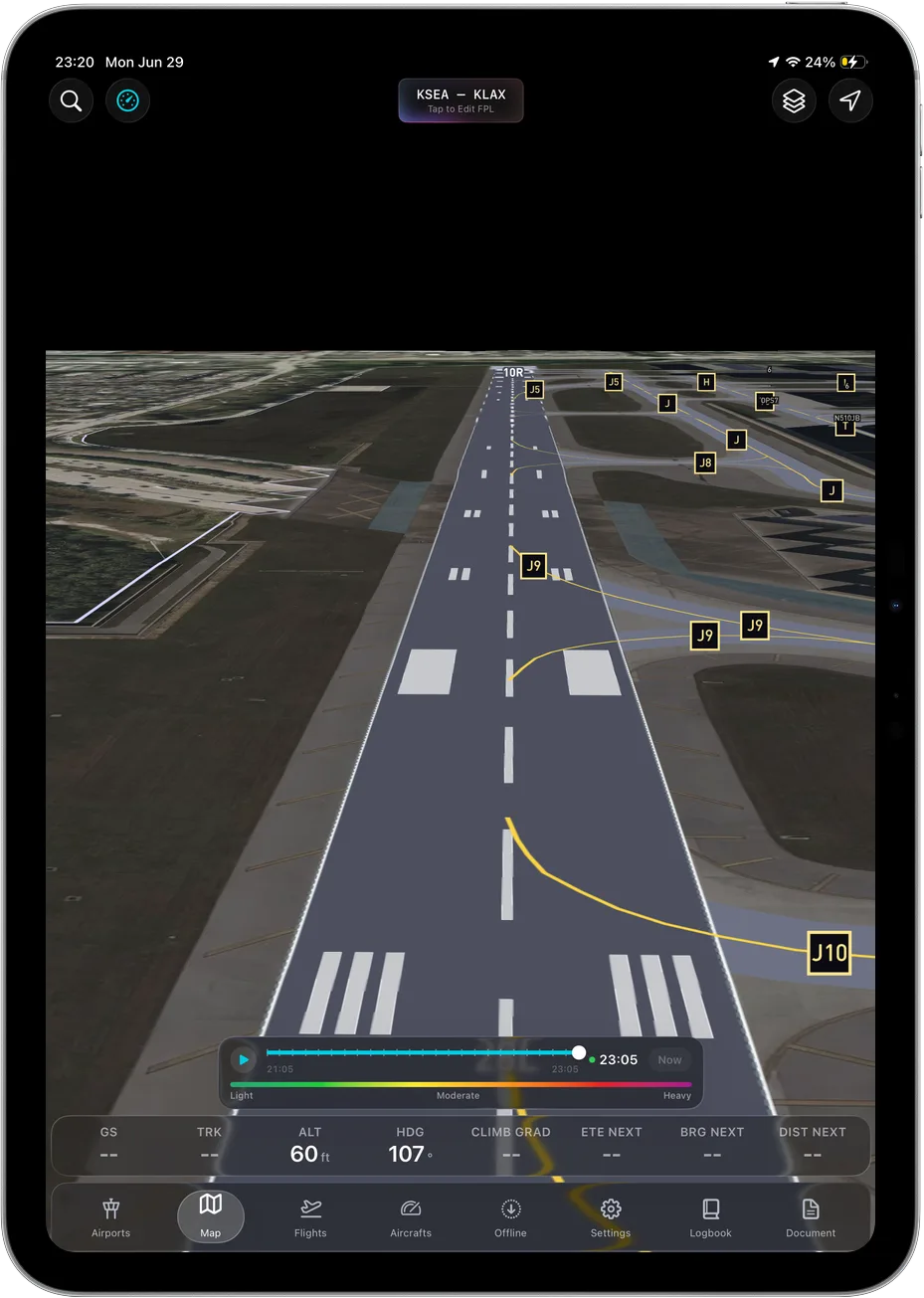 3D terrain, and it keeps working with no signal at all.
A 3D terrain view collapses those four operations into one. You are comparing a shape to a horizon instead of comparing a number to a number. That is the whole idea, and it is the reason Ascent exists rather than a feature we added to a premium tier.
Two honest limits, because this is the part where marketing usually runs off the road. Terrain rendering is a supplemental aid to situational awareness. It is not obstacle clearance and it is not a certified terrain warning system, and published minimum altitudes stay the authority. And in Ascent your own aircraft is a 2D heading-up puck on the map, not a 3D model of your airplane. The terrain is the three-dimensional part.
Feature by feature
| Ascent EFB | ForeFlight | |
|---|---|---|
| Price | $59.99 first year, $89.99 after | $130 Starter, $260 Essential, $390 Premium |
| Plans to choose between | One | Three |
| 3D terrain | Yes, in the one plan | Synthetic vision, listed above the Starter tier |
| Geo-referenced FAA charts | Yes | Yes |
| VFR Sectionals and Terminal Area Charts | Yes | Yes |
| IFR Enroute Low, High and Area charts | Yes | Yes |
| Geo-referenced approach plates | No | Yes |
| Weather: METAR, TAF, radar, winds, AIRMET, SIGMET | Yes | Yes |
| Live traffic | Yes | Yes |
| Taxi diagrams and airport info | Yes | Yes |
| Charts and 3D terrain fully offline | Yes | Yes |
| Platforms | iPhone, iPad | iPhone, iPad |
| Track record | Launched August 2026 | Well over a decade |
Every ForeFlight cell above reflects what ForeFlight publishes on its own pricing page and feature list, read August 7, 2026 and checked again August 26, 2026. Plans, prices and tier contents change, so check the current page before you buy.
Ascent EFB
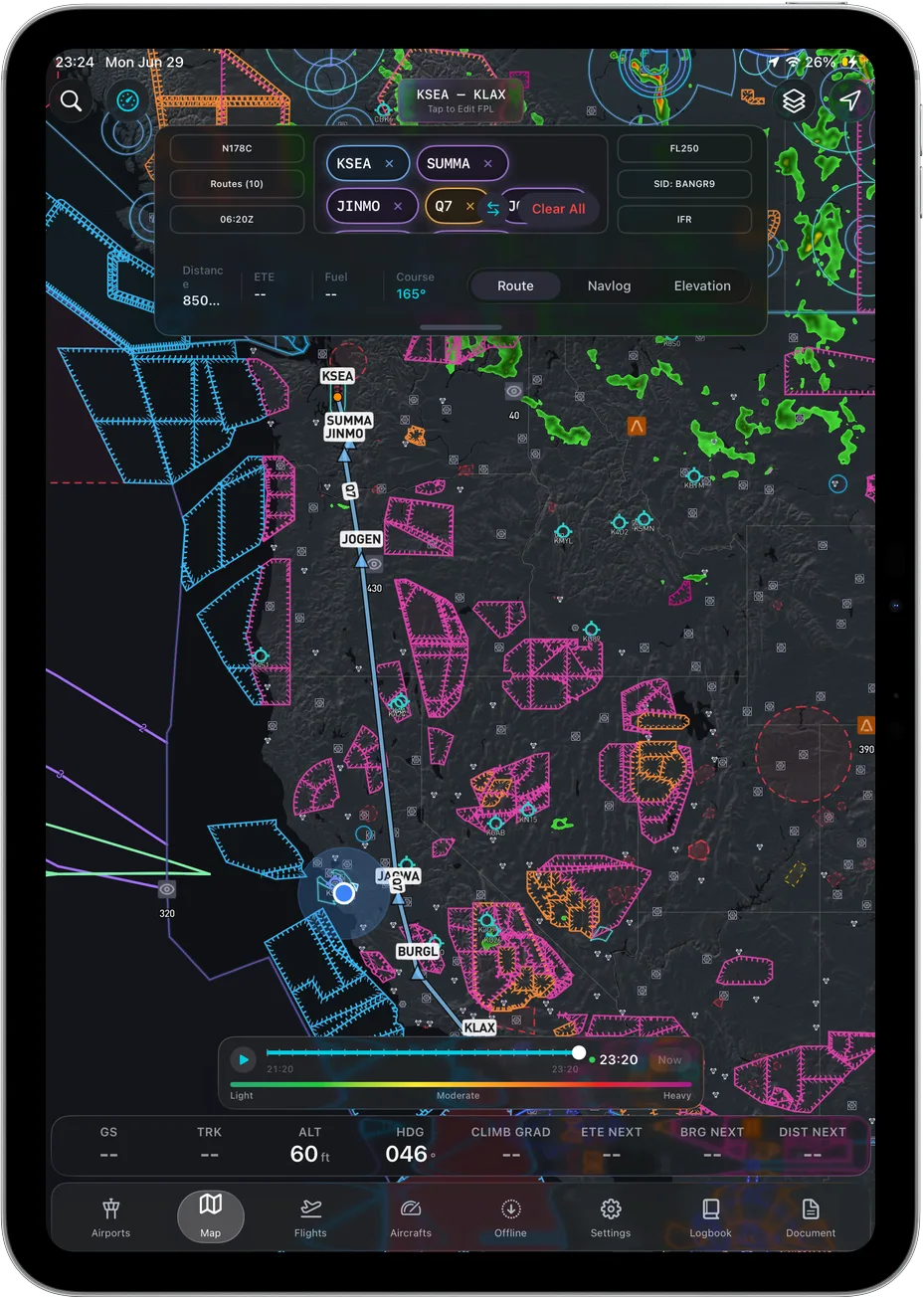 One plan, and this is all of it. No tier decides which layers you get.
Key features
3D terrain, in the only plan there is. Geo-referenced FAA charts, VFR Sectionals and Terminal Area Charts, plus IFR Enroute Low, High and Area. The full weather stack: METAR, TAF, radar, winds aloft, AIRMET and SIGMET. Live traffic. Airport information and taxi diagrams. And full offline caching, which in our case means the whole app rather than a subset of it: cache the regions you care about on the ground and the charts, the last weather you pulled, the airport data and the 3D terrain all keep working with the device in airplane mode. Ramps with no coverage are the normal case in a lot of the country, and an app should not get quieter when the bars do.
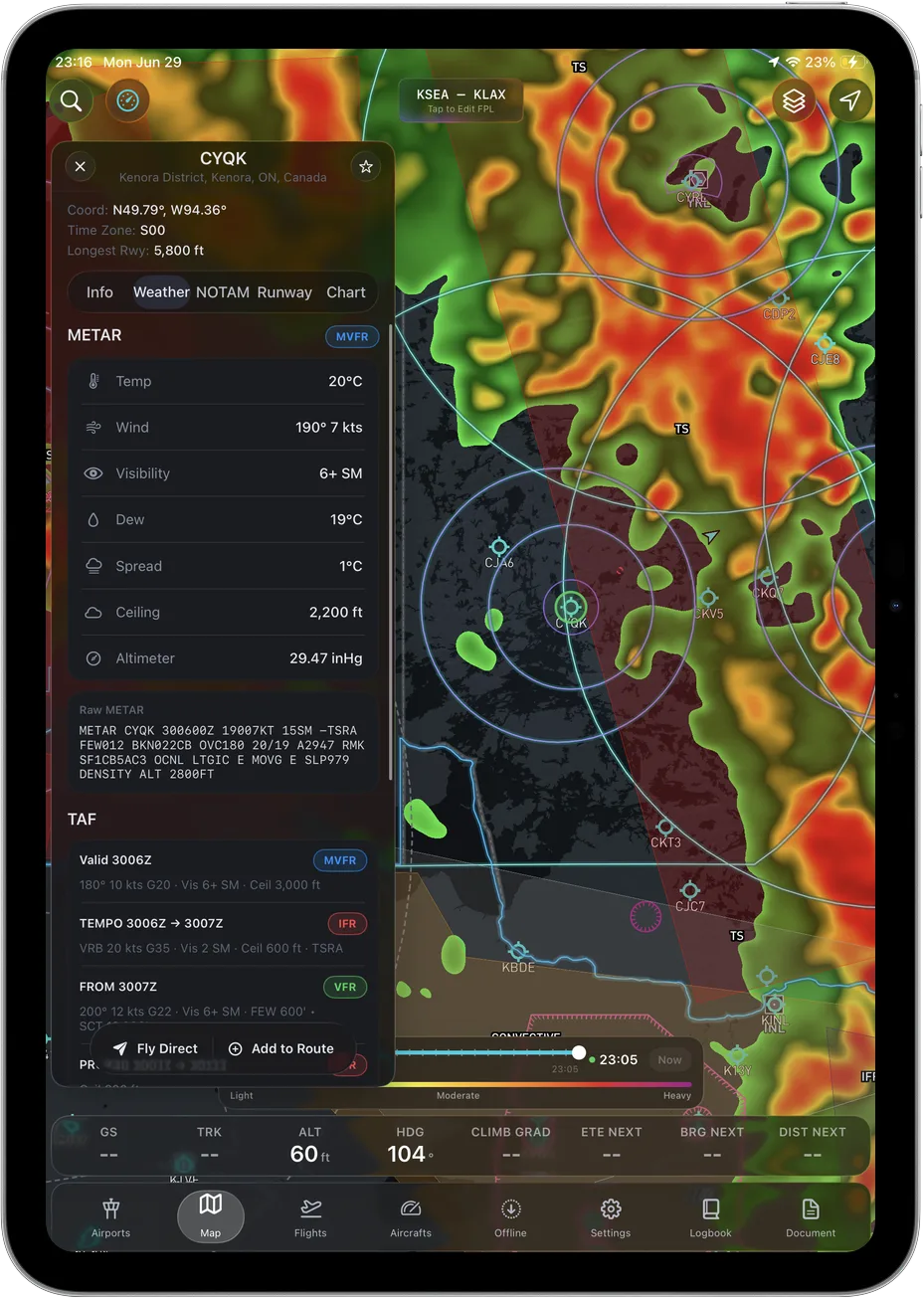 METARs and TAFs decoded in plain language, part of the base plan.
Who it suits
Pilots flying VFR and IFR enroute in general aviation aircraft who want the best situational-awareness picture per dollar, and who would rather not study a feature matrix to find out which plan contains the thing they came for. It suits mountain and unfamiliar-terrain flying particularly well, because that is the problem the app was built around. It does not suit anyone who needs own-ship on an approach plate, which ForeFlight publishes and Ascent does not, and we say so again below.
Pricing
$59.99 for the first year, $89.99 a year after that. One plan. There is nothing above it, nothing withheld pending an upgrade, and no add-on that turns on IFR data.
The third-party check
Do not take our word for the parts you can verify. The App Store listing for Ascent EFB is published by Apple, not by us: release dates, version history, device requirements, size and ratings all live there.
ForeFlight
Key features
Per ForeFlight's own published feature list, read August 7, 2026 and checked again August 26, 2026: geo-referenced VFR and IFR charts, geo-referenced approach charts with own-ship, synthetic vision, weather, traffic, airport and taxi information, performance and weight and balance planning, and a long list of integrations with panel avionics, ADS-B receivers and dispatch tooling.
Who it suits
Pilots who fly instrument approaches and want their aircraft symbol on the plate. Operators and flight departments whose workflow, hardware and paperwork already run through it. Anyone who wants the app with the longest field record in this category, which is a legitimate thing to want.
Pricing
Per ForeFlight's published pricing page, read August 7, 2026: $130 Starter, $260 Essential, $390 Premium. The same page lists synthetic vision and geo-referenced approach charts under the tiers above Starter, so the honest comparison for most pilots is not against $130. It is against whichever tier carries the capability they actually came for.
The third-party check
ForeFlight publishes its pricing page, its plan comparison and its system requirements. Every ForeFlight sentence on this page traces to one of those three, with the date we read it. If you find a line here that does not, we got it wrong and support@geospatios.com is the fastest way to tell us.
Where ForeFlight still wins
Writing a comparison that pretends otherwise would insult you and would be easy to disprove.
Geo-referenced approach charts. This is the specific one. ForeFlight publishes approach charts with own-ship position on the plate. Ascent does not have them, today. If you shoot an RNAV approach into an unfamiliar field, seeing your airplane on the plate is worth real money, and no amount of terrain rendering substitutes for it. That single row is a good enough reason to buy ForeFlight instead of us, and we would be lying if we dressed it up.
Weight and balance, and performance planning. ForeFlight's published feature list includes weight and balance and aircraft performance profiles. Ascent has neither. If your club or your checkout requires a generated W&B sheet, that ends the discussion before price enters it.
The ecosystem. Panel avionics, ADS-B receivers, dispatch and flight-department tooling, and the fact that everyone in the right seat already knows where the buttons are. Compatibility is a feature. If your operation is already built around ForeFlight, ripping it out to save a hundred dollars is bad math.
Track record. More than a decade of real flying, in weather we have not seen yet, across operations we do not serve. Ascent launched in August 2026. Maturity is earned in hours and they have vastly more of them.
Who should not buy Ascent EFB
Skip us, genuinely, if you fly IFR approaches and want own-ship on the plate. Skip us if you need weight and balance in the same app. Skip us if you fly an Android tablet, because Ascent is iPhone and iPad only and there is no Android version. Skip us if your flight department standardised on something else, or if a decade of track record is the thing you are actually buying.
What is left is a large group: pilots who fly VFR and IFR enroute, who want charts, weather, traffic and terrain that all work with the device in airplane mode, and who would rather spend the difference on fuel.
How to decide in one flight
ForeFlight publishes a 30-day free trial on its pricing page, read August 7, 2026, so evaluating that one costs you flying time and nothing else. Ascent EFB is $59.99 for the first year, which is roughly what half an hour of dual costs.
Either way the test is the same, and it is not reading a table. Plan one real cross-country. Brief the weather in the app. Put the device in airplane mode on the ramp and see what survives. Fly with it on your knee, and count the taps when you actually need something. Then look at the terrain on a descent into somewhere with real rocks around it, and notice whether you are reading a shape or decoding a number.
We think you will keep Ascent EFB. We would rather you find that out in an airplane than take our word for it.
Frequently asked questions
Is Ascent EFB cheaper than ForeFlight?
Yes. Ascent EFB is $59.99 for the first year and $89.99 a year after that, with everything included. ForeFlight's published plans start at $130 and go to $390, with capabilities distributed across those tiers, per their pricing page read August 7, 2026.
What is Ascent EFB?
Ascent EFB is an electronic flight bag app for iPhone and iPad from Geospatios, launched in August 2026. It covers geo-referenced VFR and IFR enroute charts, weather, live traffic, airport info, taxi diagrams and 3D terrain, all available offline, in one plan. It is on the App Store here.
Does Ascent do everything ForeFlight does?
No, and the gap is specific rather than vague. ForeFlight publishes geo-referenced approach charts, weight and balance and performance planning; Ascent has none of those today. Ascent covers the core flight: 3D terrain, geo-referenced VFR and IFR enroute charts, full weather, live traffic, airport info and taxi diagrams, all offline.
How do I evaluate the two before paying?
ForeFlight publishes a 30-day free trial on its pricing page, read August 7, 2026. Ascent EFB is $59.99 for the first year. Whichever way in you take, fly the same cross-country with both, brief it in the app, and spend part of it in airplane mode so you learn what each one does with no signal.
Does Ascent EFB run on Android?
No. Ascent is iPhone and iPad only, and we would rather say that plainly than let you find out after paying.
ForeFlight pricing, plan structure and feature list were read from ForeFlight's own published pages on August 7, 2026 and re-checked on August 26, 2026, and they change over time. Ascent is our product, so treat our opinions as ours; every factual claim about ForeFlight here is limited to what they publish themselves, and we encourage you to verify it. Any EFB is a supplemental aid to situational awareness, and final authority rests with the pilot in command.
Try Ascent EFB
Free for 30 days, then $59.99 your first year
One plan with everything in it: 3D terrain, geo-referenced FAA charts, the full weather stack and live traffic, all cached offline. $89.99 a year after the first. One trial per account, no card needed to look around.
Start a 30-day trial