Comparisons
ForeFlight vs Garmin Pilot 2026: What You'll Actually Pay
August 6, 2026 · 13 min read · by Vincent Wu, Founder, Ascent EFB · Updated August 26, 2026
Try Ascent EFB
Free for 30 days, then $59.99 your first year
One plan with everything in it: 3D terrain, geo-referenced FAA charts, the full weather stack and live traffic, all cached offline. $89.99 a year after the first. One trial per account, no card needed to look around.
Start a 30-day trialTL;DR: ForeFlight and Garmin Pilot are both excellent, and the feature rows on their spec sheets look nearly identical. That is exactly why the spec sheet is the wrong thing to compare. What separates EFBs in 2026 is how fast the app answers a question when you have one hand on the yoke, and you cannot read that off a table. On price, ForeFlight publishes $130 to $390 a year and Garmin Pilot $109.99 to $209.98, with the headline features above the entry tier on both. Ascent EFB is one plan at $59.99 the first year, $89.99 after, with 3D terrain, full weather and full offline in it. Every account also gets a one time 30 day Pro trial, so you can fly it before you pay for it.
Which is better, ForeFlight or Garmin Pilot? Neither wins on features. Both cover charts, weather, traffic, terrain and planning. The real decision is your panel, your platform, and which tier carries what you want: ForeFlight publishes $130 to $390, Garmin Pilot $109.99 to $209.98, both checked August 26, 2026. Ascent EFB is one plan at $59.99 the first year.
Methodology, and yes we are biased. We build Ascent EFB, so we have a horse in this race and you should read us that way. The rule we hold ourselves to: every factual claim about ForeFlight or Garmin Pilot below comes from that company's own published page, with the date we read it, and nothing about a competitor is characterised in our voice. ForeFlight plan names, prices and tier contents were read from foreflight.com/pricing on August 26, 2026. Garmin Pilot's US Standard and US Premium prices were read from Garmin's own published US plan catalog on August 8, 2026. If a claim could not be sourced that way, it is not in this post.
At a glance
| App | Best for | Key strengths | Price (USD/yr) |
|---|---|---|---|
| ForeFlight | Pilots who want the deepest ecosystem | Long published compatible-hardware list, deep integrations, tiers up to Premium | $130 Starter, $260 Essential, $390 Premium |
| Garmin Pilot | Garmin panels and Android tablets | Garmin panel integration, published on both App Store and Google Play | $109.99 US Standard, $209.98 US Premium |
| Ascent EFB | 3D terrain awareness and offline flying at one price | 3D terrain, geo-referenced FAA charts, full weather, live traffic, full offline caching, no tiers | $59.99 first year, then $89.99, one plan |
The spec sheet is not the difference
Line up the three feature lists and they rhyme. Charts, weather, traffic, terrain, planning, airport data. Every mature EFB has those rows, and any of these apps will get you through a cross-country.
Flighty and a browser flight tracker also technically show you the same flight. Nobody who has used both thinks they are the same product.
That is the real state of EFBs right now. The incumbents were architected a long time ago, and the age shows the moment you open them, in how many taps a question costs and how much decoding your brain has to do before the picture means anything. None of that appears in a comparison table, which is why comparison tables keep telling pilots these apps are interchangeable when the people who fly them daily know they are not.
So the honest way to run this comparison is: assume the features are a wash, then ask which app puts the answer in front of you fastest for the flying you actually do.
The three apps, same questions
Same four questions for each, in the same order, so you can compare like for like.
ForeFlight
Key features. Geo-referenced charts and plates, flight planning and filing, a deep weather stack, traffic and terrain awareness, a moving map, logbook, and a long published list of compatible third-party hardware. ForeFlight's own pricing page lists Synthetic Vision, Geo-Referenced Approaches & Charts and Hazard Advisor as Essential features rather than Starter features.
Who it suits. Pilots who want the deepest ecosystem and the most integrations, flight departments, and anyone who already lives in ForeFlight's workflow and does not want to relearn one.
Pricing. $130 Starter, $260 Essential, $390 Premium, per foreflight.com/pricing. The capabilities most pilots go shopping for are at Essential, so budget the middle tier, not the sticker.
Sourced note. Plan names, prices and tier contents read from foreflight.com/pricing on August 26, 2026. ForeFlight's own published support documentation states the app runs on iPhone and iPad and that there are no plans for an Android version, checked August 26, 2026.
Garmin Pilot
Key features. Charts, planning and filing, weather, traffic and terrain, and integration with Garmin panel avionics and Garmin ADS-B receivers. The interface deliberately echoes Garmin's touchscreen units, which is the point if that is what is in your panel.
Who it suits. Pilots flying behind Garmin avionics, and pilots on Android, which is a category ForeFlight does not serve at all.
Pricing. $109.99 US Standard, $209.98 US Premium, per Garmin's own US plan catalog. Read Garmin's feature comparison for the tier and platform you are actually buying, because the plans differ in what they carry.
Sourced note. US Standard and US Premium prices read from Garmin's published US plan catalog on August 8, 2026. Platform availability from Garmin Pilot's own App Store and Google Play listings, checked August 26, 2026.
Ascent EFB
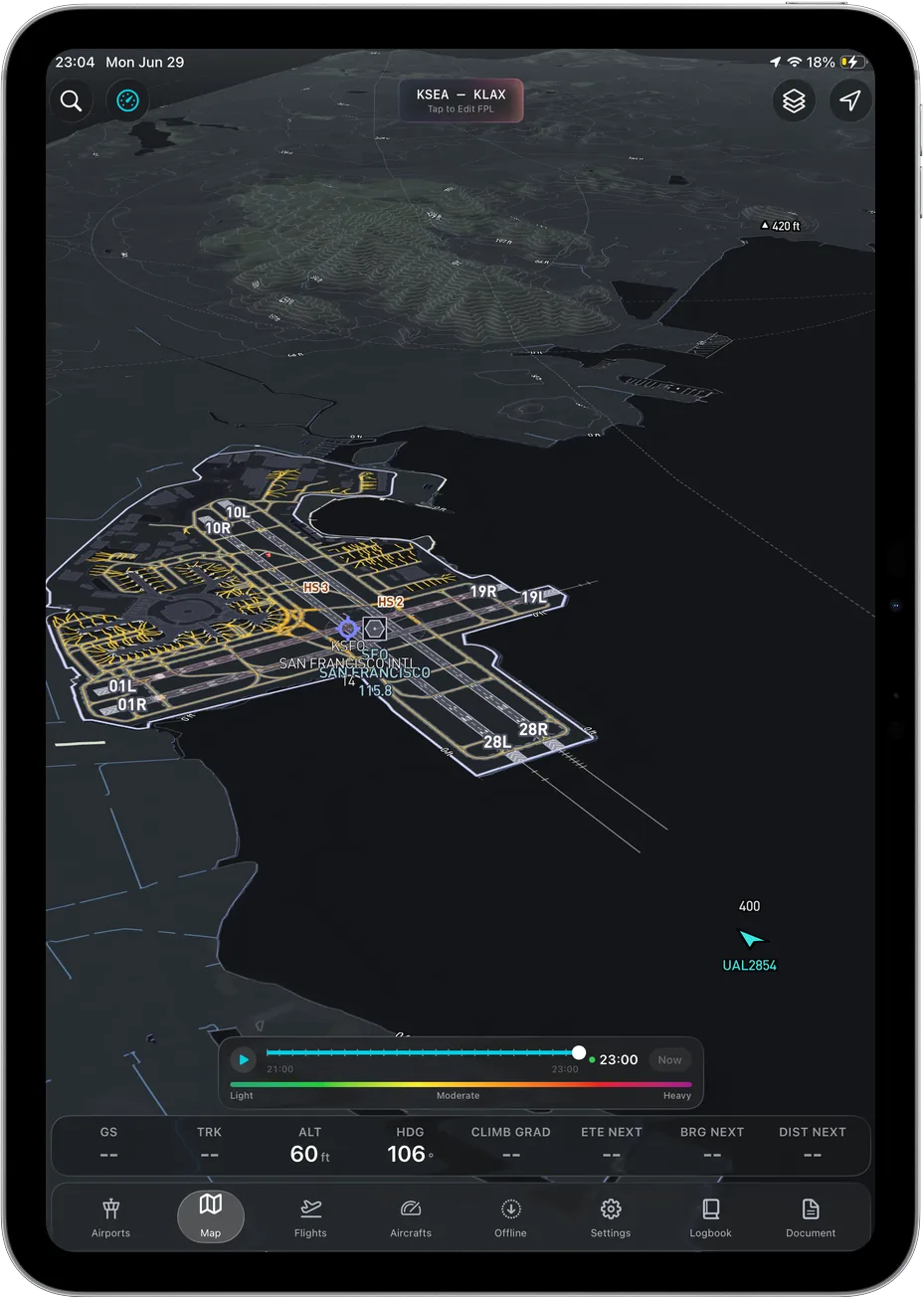 3D terrain in Ascent EFB. It is in the one plan, not a tier above it.
Key features. 3D terrain, which is the reason to look. Geo-referenced FAA charts including VFR Sectionals, Terminal Area Charts and IFR Enroute Low, High and Area. A full weather stack: METARs, TAFs, radar, winds aloft, AIRMETs and SIGMETs. Live traffic, airport information, geo-referenced taxi diagrams, and full offline caching. One plan, so there is no upgrade screen, because there is nothing above you to upgrade to.
Here is where the design argument stops being an argument and becomes something you can look at. Flying a night arrival into rising terrain, or scoping a mountain pass before you commit, is a fundamentally different task in three dimensions than it is on a flat map where you decode elevation off contour shading and spot heights. The chart has the same information. It does not hand it to you in the half second you actually have. Ascent renders the terrain around your route in 3D so you read the shape of the ground the way you read it out the window, and it is in the base plan rather than a tier above it.
The offline behaviour matters for the same reason. Charts and the 3D terrain map both work with the tablet in airplane mode, which is the state most of us fly in anyway. Cache before you leave and the app does not care about cell coverage over the ridge.
Who it suits. iPhone and iPad pilots who want terrain awareness and full offline without climbing a tier ladder, and who would rather pay once for everything than audit a feature matrix before checkout.
Pricing. $59.99 the first year, $89.99 a year after that. One plan. No tiers, no add-ons.
Sourced note. This one is ours, so it is not third party and you should not treat it as such. Verify it yourself on the App Store listing and on ascentefb.com before you buy. What we will not oversell: your own aircraft shows as a 2D heading-up puck, not a 3D model. The terrain is the three dimensional part. Ascent is iPhone and iPad only, it launched in August 2026 so it has nothing like the legacy depth of either incumbent, and it does not have geo-referenced approach plates or synthetic vision.
Where ForeFlight still wins
Specifically: geo-referenced approach plates. ForeFlight's own pricing page lists Geo-Referenced Approaches & Charts as an Essential feature, which means own-ship position drawn on the approach plate itself. Ascent does not have that. If you shoot approaches in hard IFR and you have gotten used to seeing your airplane on the plate, that single capability is worth more to you than everything else on this page, and you should stay where it is.
Add to that the ecosystem around it. ForeFlight publishes a long list of compatible third-party hardware and integrations, checked August 26, 2026, and that list is the reason a lot of panels, receivers and workflows assume ForeFlight by default.
Choose ForeFlight if you fly hard IFR and want own-ship on the approach plate, if a specific piece of hardware in your airplane lists ForeFlight support and not the others, or if you are already fluent in it and switching costs you more attention than the price difference is worth.
Where Garmin Pilot still wins
Specifically: your panel. If you fly behind Garmin avionics, the app talks to the hardware you already own. Garmin publishes that panel connectivity on its own Garmin Pilot product pages, checked August 26, 2026, including flight plan transfer between the tablet and the panel. That is a daily-workflow advantage no amount of app design elsewhere replaces.
Second, Android. Garmin Pilot is published on Google Play as well as the App Store, checked August 26, 2026. ForeFlight is not, per ForeFlight's own support documentation. Neither is Ascent EFB.
Choose Garmin Pilot if your panel is Garmin, or if anyone in your flying uses an Android tablet. On the Android point there is no debate to have. It ends the discussion by itself, and if that is you, stop reading here.
What to actually compare
If you take one thing from this post, take this table rather than the price table. These are the seven things that decide whether an EFB works for you, and none of them are visible in a feature-count.
| Consideration | Why it matters | What to look for |
|---|---|---|
| Chart currency and AIRAC | Flying an expired plate is a paperwork problem and a real one. Cycles change every 28 days | How the app tells you a cycle expired, whether updates download in the background, and how big the download is |
| Offline coverage | Cell coverage at altitude is not a plan, and neither is a hangar with bad Wi-Fi | Whether charts, plates, weather products and terrain all cache, or only some of them, and how you tell what is cached |
| Traffic | Traffic is only useful if you believe it fast enough to act on it | Where traffic comes from, whether it needs a receiver, and how the display behaves when there are twelve targets and one that matters |
| Weather sources | Every app shows METARs. They differ in how quickly you form a picture | Whether the briefing is a wall of text or a picture you can read, and what the app does with the tablet offline |
| Terrain | This is where design shows most. A flat chart makes you decode elevation, a 3D view hands it to you | Whether you can see the shape of the ground at a glance on a night arrival, and whether it is in the plan you are buying or a tier above it |
| iPad hardware | The app is the easy part, the glass is the hard part | Screen brightness in direct sun, thermal behaviour on a yoke mount, and whether the tablet has a real GPS receiver |
| Price, at the tier you need | Entry prices are marketing. The tier that carries your features is the real price | Price out the tier that has what you will actually use, then compare those two numbers |
Which tier do you actually need?
Panel and platform are handled above, and for a lot of pilots one of those two ends the discussion before price comes up. If neither does, this is the part most comparisons gloss over, and it is where the real money is.
Both incumbents sell in tiers, and on both, the capabilities pilots most want are not in the entry plan. ForeFlight's own pricing page lists Synthetic Vision, Geo-Referenced Approaches & Charts and Hazard Advisor as Essential features, which is the $260 tier, not the $130 Starter tier, read August 26, 2026. Garmin publishes a US Standard plan at $109.99 and a US Premium at $209.98, read August 8, 2026, so read Garmin's own feature comparison for the tier you are buying.
So the honest comparison is not $130 against $109.99. It is: price out the tier that carries the features you will actually use, then compare those two numbers. For a lot of IFR pilots that means the middle or upper tier on either platform, and the gap narrows or flips depending on what you need. Ascent EFB has one plan at $59.99 the first year and $89.99 after, so there is no tier arithmetic to do on our side, which is the entire point of selling it that way.
How to decide in one month
ForeFlight and Garmin Pilot each publish a 30-day free trial on their own sites, checked August 26, 2026, so the cheapest possible way to choose between those two is to fly both.
- Plan one real cross-country in each, start to finish, including fuel and weight and balance.
- Brief the weather in each and see which picture you trust faster.
- Fly with each on your lap, in the aircraft you actually fly.
- Divert mid-flight in each and see which keeps up.
- Put the tablet in airplane mode on the ramp and see how much of the app is still there.
Count taps, not features. Whichever one you stop fighting first is your answer, and that is the measurement the spec sheet cannot make for you.
Frequently asked questions
Is ForeFlight or Garmin Pilot better for VFR flying?
For pure VFR, both are more capable than most VFR pilots need, and the entry tiers cover it. Decide on panel integration, platform, and price. If price is the deciding factor and you are on iPad, Ascent EFB is $59.99 the first year with everything in one plan.
Can I use ForeFlight on Android?
No. ForeFlight publishes iPhone and iPad apps only, and their own support documentation states there are no plans for an Android version, checked August 26, 2026. Garmin Pilot is published on Google Play. Ascent EFB is iPhone and iPad only, so Android pilots should look at Garmin Pilot.
Which is cheaper, ForeFlight or Garmin Pilot?
At the entry tier Garmin Pilot is cheaper, $109.99 against $130. Compare the tiers that carry the features you need rather than the starting prices, because that is where the difference actually lands. Ascent EFB is cheaper than either at $59.99 the first year and $89.99 after, with no tier above it.
What is the cheapest way to get 3D terrain awareness?
In this comparison, Ascent EFB, because 3D terrain is in the single plan: $59.99 the first year and $89.99 a year after. ForeFlight lists Synthetic Vision under its $260 Essential tier per its own pricing page, read August 26, 2026. Price out the tier you would actually need on each before you decide.
If the features are the same, why would I switch at all?
Because the features being similar is the point. When three apps list the same rows, the thing that separates them is how quickly each one answers a question in flight, which you can only find out by flying them. Terrain is the clearest place to see it: a 3D view of a mountain pass and a contour-shaded chart of the same pass carry the same data and cost you very different amounts of attention.
ForeFlight plan names, prices and tier contents were read from foreflight.com/pricing on August 26, 2026, and its platform support from ForeFlight's own published support documentation on the same date. Garmin Pilot's published US Standard and US Premium subscription prices were read from Garmin's own US plan catalog on August 8, 2026, and its platform availability from its App Store and Google Play listings on August 26, 2026. Prices change, so verify on the vendor's page before you buy. Ascent EFB is our product, and we have kept every claim about ForeFlight and Garmin Pilot to what they publish themselves. Any EFB is a supplemental aid to situational awareness, and final authority rests with the pilot in command. Also see The Best EFB Apps in 2026, Compared.
Try Ascent EFB
Free for 30 days, then $59.99 your first year
One plan with everything in it: 3D terrain, geo-referenced FAA charts, the full weather stack and live traffic, all cached offline. $89.99 a year after the first. One trial per account, no card needed to look around.
Start a 30-day trial